How to measure a room for new furniture
Step-by-step guide
4 min leestijd
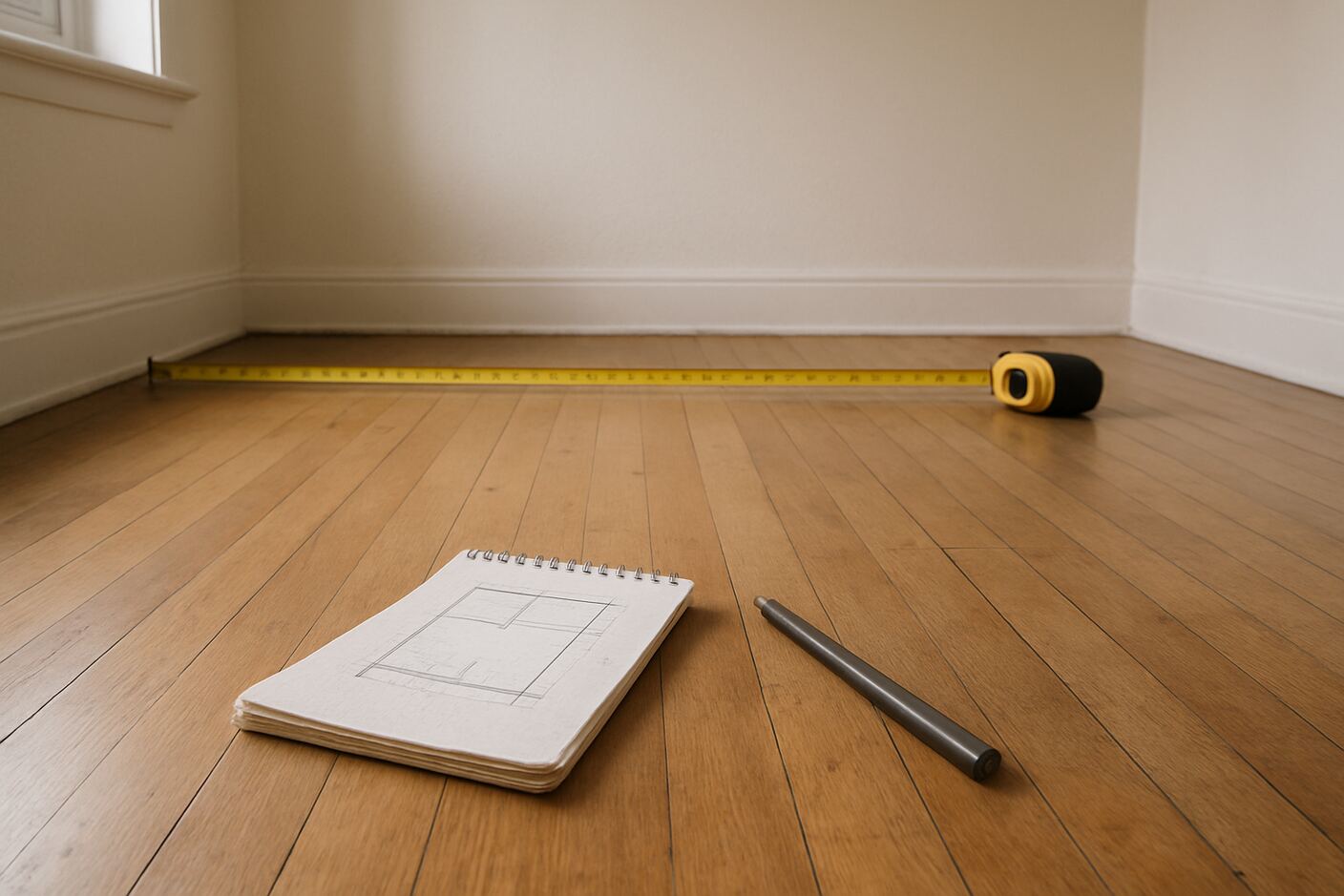
How many people buy a sofa, see it arrive two weeks later, and only then realise it won't fit through the front door? Too many. How many people place a new dining table only to discover they can't pull the chairs out? Also too many. Measuring a room properly takes twenty minutes and saves you hundreds — sometimes thousands. Here's how.
What you need
• A tape measure of at least 5 metres (a short 2-metre tape isn't enough). • Pen and paper (or the Notes app). • Optional: a laser distance meter (€15–30, hugely easier than a tape for larger distances).
iPhone Pro or recent Android? The Measure app is surprisingly accurate. Double-check with a tape though — apps sometimes deviate 2–5 cm, and for furniture that's often fatal.
Step 1 — Sketch a floor plan
Start with a simple top-down sketch. Doesn't need to be to scale — but include every wall, door, window, radiator, and obstacle. Mark: • Every door (and which way it opens). • Every window (and the windowsill height). • Every radiator and power outlet. • Every column or jut in a wall.
Many people forget to mark radiators, place a sofa in front of one, then have to push it forward 20 cm — wiping out the walkway behind it.
Step 2 — Measure all wall lengths
Per wall, at both 30 cm height and table height (75 cm) . Why two heights? Older Dutch homes often have protruding skirting and trim, so the usable space at floor level differs from at furniture height. The difference can be up to 5 cm — more than enough to make a sofa "almost fit." Write measurements directly on your floor plan. Always double-check: total length of opposite walls should match (in old skewed houses they often don't).
Step 3 — Measure all obstacles
• Door width and height (without the frame). • Windowsill height and depth. • Radiator dimensions (width, height, depth from wall).
• Stairwell dimensions and turn point if pieces have to go upstairs. • Lift dimensions in apartment buildings — width, depth, height, and door opening.
Everyone skips this. Don't. Half of "the sofa doesn't fit in my home" problems start here.
Step 4 — Determine the "free zone"
Use a pencil to mark off areas that can't be used: • 30–60 cm in front of radiators (can't be blocked for circulation). • 80–100 cm for inward-opening doors. • 60 cm walkway along every route you use daily. • 30 cm clear of windows on each side (otherwise you can't open them).
What's left is your actually usable furniture zone. Often much smaller than you thought.
Step 5 — Tape it out with newspaper
For big pieces: cut the outline to size and tape it on the floor. Walk around it for a few days. See how the walkway feels. Try to live normally with the "paper sofa." Oldest trick in the book, still works like nothing else. A paper sofa feels real after three days — and if it gets in the way, you know it before spending €1,500.
Step 6 — Think in height
The forgotten dimension: • A tall bookcase under a sloped ceiling may not fit. • A long sofa back in front of a windowsill looks wrong. • A dining lamp at the wrong height hangs in front of people's eye line (too low) or looks adrift (too high).
Rules of thumb: • Dining lamp : bottom 60–80 cm above the table. • Floor lamp : at sofa back height. • Kitchen wall cabinets : 50–60 cm above the counter.
Step 7 — Visualise in your actual room
With good measurements you know what fits — not how it looks. Tools like Veyra let you upload a photo of your real room and see how specific furniture, at the right scale, sits in your space. No to-scale floor plan needed to check whether a 220 cm sofa visually works in your 4 m wide room. You see it directly.
Common mistakes
• Only measuring floor area, not walkway. Your piece fits — but you can't walk past it. • Forgetting that doors swing open. An 80 cm door needs 80 cm of clear arc. • Not measuring the diagonal. A 220 cm sofa may not pass straight through a 90 cm front door, but might via the diagonal. Ask the retailer for the diagonal dimension on big buys. • Ignoring ceiling height. Critical for tall cabinets and pendant lights.
Frequently asked
Average ceiling height in the Netherlands? Modern new-builds 2.60 m. 1930s houses 2.80–3.20 m. Monumental homes 3.20+ m. Loft floors vary (watch the slopes). How much walkway around a dining table? At least 60 cm between table and wall or furniture to pull a chair out. 80 cm is comfortable for walking past someone seated. Average depth of a Dutch living room? 3.5–4.5 m for most terraced houses. Through-room layouts typically 3.5–4 m wide and 6–8 m deep.
Zie het eerst. Koop het dan.
Upload een foto van je kamer en Veyra laat je echte meubels zien, geplaatst in je eigen ruimte — binnen een minuut.
Probeer Veyra gratis