How to furnish a small studio apartment
Maximum living in minimum space
5 min leestijd
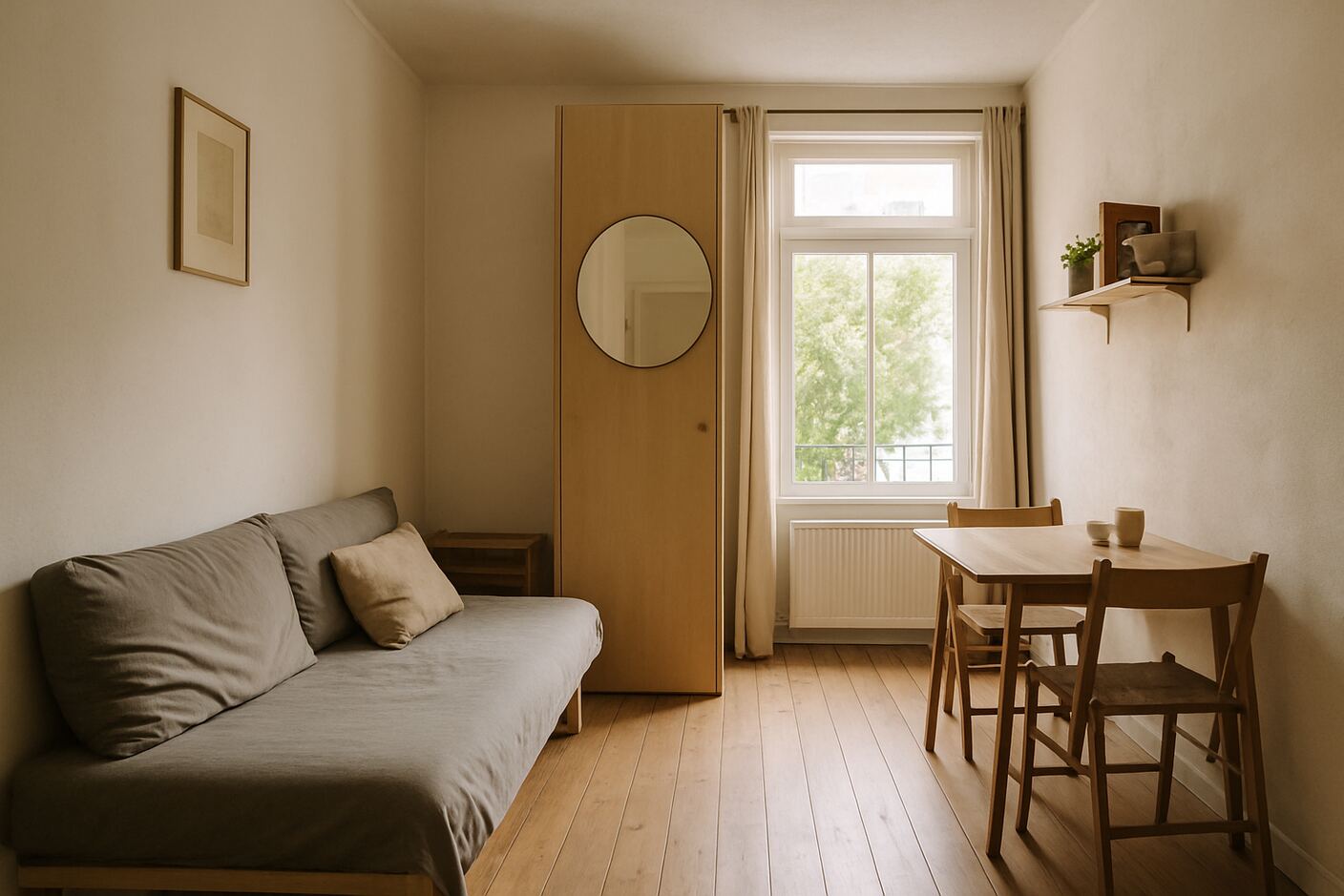
A studio isn't a small living room. A studio is a home that's one room. Living, sleeping, eating, working, and hosting in 25 to 40 square metres calls for different choices — not just "smaller," but fundamentally different. Here's how to furnish a studio that doesn't feel like a compromise but a deliberate choice. Based on real studio dwellers in Amsterdam, Rotterdam, Utrecht, and Eindhoven.
The core principle: zones, not rooms
In a studio you don't need to imitate every "room" of a house in miniature. Bad studios do that — a tiny seating bench, a tiny dining table, a mini-desk, a single bed, all next to each other. What you get is a space that's half-present in six spots and never feels complete anywhere. Good studios think in zones : areas for activities that overlap and share what they can share. • Sofa + workspace = same place (laptop on lap). • Dining table + desk = same place (fold up, fold down). • Bed + seating area separated visually but not by a wall.
Eight key zone choices
-
Bed: open, semi-open, or hidden? • Open : bed visible, often a loft bed or in a separate corner. Simple, cheap. • Semi-open : an open wardrobe or hanging curtain as visual separation. The middle path and often best for those who host regularly. • Hidden : a Murphy bed (folds into the wall) or sofa bed. Maximum flexibility — but daily folding is something most people stop doing within three months.
-
Sofa: sofa bed, regular sofa, or no sofa? In studios under 30 m² a 2.5-seater is often verging on unwise. Consider: • Big floor cushions (Moroccan style) — maximum flexibility. • A backless chaise longue against the wall — social and compact. • A sofa bed — only if you'll genuinely fold it daily. Seriously.
-
Dining table: fold-out or fixed? Solo dweller: a fold-out table on the wall, closed 80% of the time. Don't waste scarce floor space. Couple or frequent dinner hosts: a fixed 100–120 cm table that doubles as a desk. Not smaller — anything smaller becomes pitiful. 4. Storage: think vertical All storage goes up. Ceiling-height cabinets above the bed, shelves to the ceiling above the sofa, hanging cabinets above the kitchen counter. Floor space is gold. 5. Lighting: multiple sources
Nothing makes a studio feel smaller than one central ceiling lamp flattening everything. Work with: • One floor lamp by the seating area. • One reading lamp by the bed. • One pendant above the dining/desk table. • Optional LED strips under open shelving.
Four light sources for different moods — bright during the day, intimate at night. 6. Rug: one big one, not several One large rug under both seating area and bed connects the room. Smaller separate rugs chop it into pieces. 7. Colour: stay light, accent dark Keep the base room light (off-white, soft beige, light grey) and add one heavier element (a dark wall behind the bed, a dark cabinet, a statement rug) to create depth without darkening the room. 8. Personality: one clear statement A studio shouldn't be "agreed neutral." You live here at every hour. One thing must actually make you happy — an artwork, a big plant, a vintage rug, a large mirror. Not three or four. One.
Four real-world examples
Studio Amsterdam — 28 m², 1 person, high ceilings Loft bed above the desk area (sleeps high, works below). Lounge zone with chaise + large rug. Fold-out dining table on the wall (max 2 people). One big olive tree as the statement. Studio Rotterdam — 36 m², couple, normal ceilings Double bed in a semi-open corner with a velvet curtain as separator. Bouclé chaise for 1–2 people. Fixed 100 cm table doubling as workspace. Ceiling-height bookshelf as wall statement. Studio Utrecht — 24 m², 1 person, 1930s building Loft bed above a wardrobe (wardrobe doubles as stairs). Two-seater right under the window. Fold-out table on the wall. Vintage Persian rug as statement, dim lighting. Studio Eindhoven — 40 m², 1 person, modern new-build Bed in a separate alcove. Full seating area with 2.5-seater + armchair. Dining table for 4, doubles as desk. Dark green accent wall behind the bed.
Common mistakes
Too many pieces. Two armchairs, a sofa, a pouf, and an ottoman in 30 m² is guaranteed too much. Badly placed mirrors. A large mirror can visually double a studio — but only if it reflects something good (a window, a nice corner). A mirror reflecting your cluttered corner or a blank wall adds nothing. Buying from product photos. A sofa that looks right in a showroom may not fit in your 28 m² studio — or worse, it fits but visually eats everything.
Visualise before you furnish
Studios are the least forgiving. A mistake in a regular home you hide behind a wall; in a studio it stays in view. Tools like Veyra let you upload a photo of your studio and see how different setups work — often with clever suggestions you wouldn't have thought of (a loft bed where you expected a normal bed, a chaise where you imagined a corner sofa). For a studio, that's the difference between "I love living here" and "back up for resale in three months."
Frequently asked
Studio vs. one-bedroom? Officially the same in most places, but in the Netherlands: "studio" = everything in one room (kitchen connected to seating); "1-bedroom" = separate kitchen, one living room with a sleeping area. Acceptable studio size for a couple? Under 30 m² gets challenging. 30–40 m² works for couples who give each other space. Over 40 m² is comfortable. Can I work from home in a studio? Yes, but designate a separate workspace (even a fold-out one) and use it only for work. Working from your bed or sofa wrecks your sleep.
Zie het eerst. Koop het dan.
Upload een foto van je kamer en Veyra laat je echte meubels zien, geplaatst in je eigen ruimte — binnen een minuut.
Probeer Veyra gratis